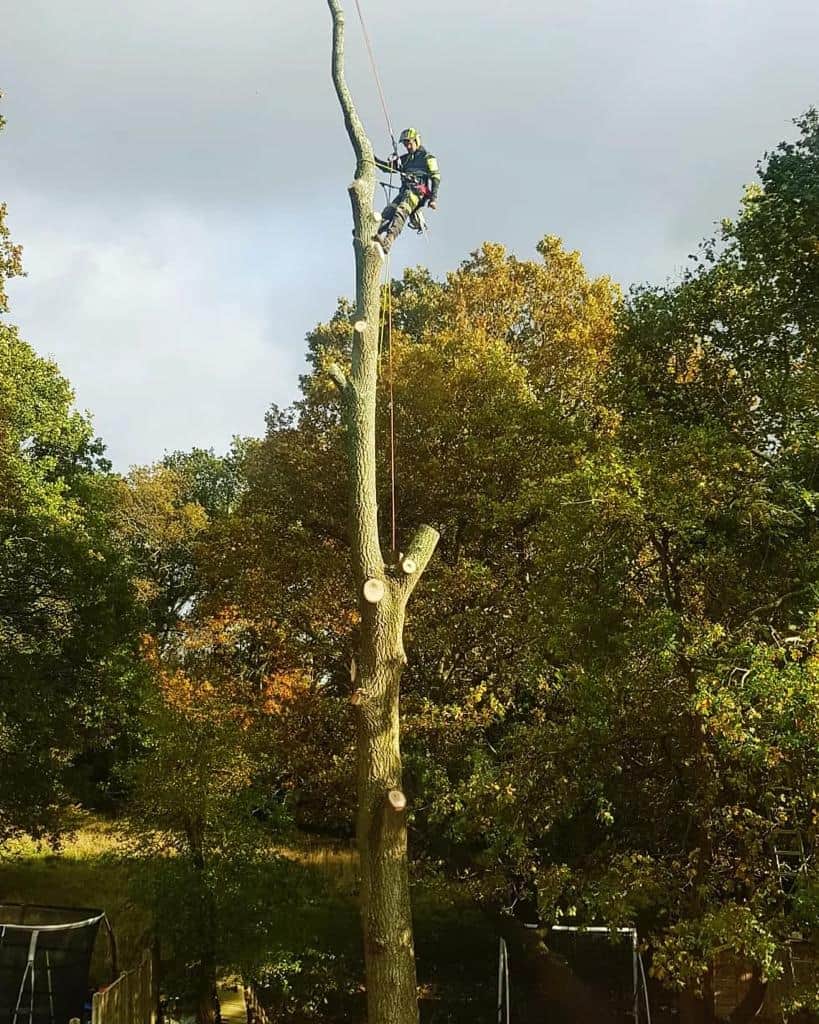
When a tree is felled, the most obvious part of the tree disappears, but the stump and root system remain in the ground. It can be tempting to leave the stump where it is, particularly if it sits towards the edge of a garden and does not initially appear to cause a problem. Over time, however, many homeowners discover that an old stump becomes increasingly inconvenient.
For homeowners in Horndean, Hampshire, stump grinding provides a practical way to deal with the remaining base of a felled tree. Removing the stump can make the garden easier to use, improve its appearance and create greater flexibility for future landscaping.
Why Are Tree Stumps Often Left Behind?
Tree felling and stump removal are separate operations.
When a tree is cut down, the trunk can be taken close to ground level, but the substantial woody base remains connected to roots beneath the soil. Removing this section manually can be extremely difficult, particularly with a mature tree.
As a result, homeowners sometimes decide that leaving the stump is the simplest option.
Initially, this may seem reasonable. The stump no longer has a large canopy above it and may appear relatively unobtrusive. The disadvantages often become clearer when the garden is used, maintained or redesigned.
A Tree Stump Can Waste Useful Garden Space
One of the most common reasons for removing an old stump is simply to reclaim the space it occupies.
A stump in the middle of a lawn, near a seating area or within a future landscaping project can significantly restrict what can be done with that part of the garden.
Removing it can provide greater freedom to:
- Extend a lawn
- Create new planting areas
- Improve garden access
- Reorganise paths
- Develop seating areas
- Make general landscaping changes
- Create a cleaner, more open layout
Even a relatively small stump can become an awkward fixed obstacle when planning changes around it.
Stumps Can Make Lawn Maintenance More Difficult
A stump positioned within a lawn can quickly become frustrating.
Mowing requires working around the obstacle each time, often leaving grass immediately beside the stump that needs separate attention.
Exposed roots can make the problem more noticeable. Depending on the original tree and site conditions, roots may remain prominent around the surrounding ground, creating an uneven area that is more difficult to maintain neatly.
Stump grinding can remove the main obstruction and allow the area to be prepared for a more practical future use.
Old Stumps Can Affect the Appearance of a Garden
After a tree has been removed, the remaining stump can make the job look unfinished.
This is particularly noticeable in well-maintained gardens where lawns, borders and other landscaping have a clean appearance.
As the stump weathers, its appearance can become increasingly different from the surrounding garden. Rather than contributing the character of a living tree, it becomes a remnant of something that is no longer there.
For homeowners trying to create a tidy, open garden, removing the stump can provide a much more complete result.
Why Not Simply Wait for the Stump to Rot Away?
Natural decomposition does eventually break down old wood, but it is not necessarily a quick process.
A substantial stump can remain in the garden for a considerable period while gradually deteriorating. During this time, it continues occupying the same space and restricting how the area can be used.
Waiting for natural decay therefore makes little sense when homeowners already have plans for the affected section of the garden.
Stump grinding provides a much more controlled solution by mechanically reducing the stump rather than relying on gradual natural decomposition.
Some Stumps Can Produce New Growth
Depending on the tree species and its condition when felled, new shoots can sometimes emerge from the stump or remaining root system.
This regrowth can be particularly inconvenient when the original purpose of felling the tree was to clear the area.
Cutting the shoots back repeatedly deals with the visible growth but does not remove the stump itself.
Where regrowth is occurring, professional assessment can help determine the appropriate approach to dealing with the remaining tree base.
Stump Removal Is Worth Considering Before Landscaping
If you are planning to redesign part of your garden, it makes sense to consider existing stumps before other work begins.
Trying to design around a stump can introduce unnecessary compromises.
For example, a planned lawn may need an awkward shape, a planting area may have to be moved or access routes may need adjusting simply because an old tree base remains in the ground.
Removing the obstruction first provides greater flexibility.
This can be especially useful before:
Creating a new lawn
A stump can interrupt what would otherwise be a smooth, continuous grassed area.
Redesigning borders
Removing the stump gives greater freedom when deciding where planting areas should be positioned.
Changing paths or access
Old stumps can restrict natural routes through the garden.
General garden renovation
Clearing redundant features before redesigning the space can make planning considerably easier.
What Is Stump Grinding?
Stump grinding is a specialist tree surgery service that uses purpose-designed machinery to mechanically reduce the remaining stump.
The cutting mechanism works through the timber, progressively grinding the stump down.
The required depth and extent of grinding will depend on the stump, its location and what the homeowner intends to do with the area afterwards.
This is different from attempting to excavate the entire root system.
A mature tree can have roots extending considerable distances through the surrounding ground. In many situations, it is the main stump that creates the practical obstruction, so grinding provides an effective way to deal with it without unnecessarily excavating a large part of the garden.
Do All the Roots Need to Be Removed?
Not necessarily.
Homeowners sometimes assume stump removal means every root connected to the former tree must be dug out.
Stump grinding generally concentrates on the main stump and the relevant surrounding area. Remaining roots beneath the ground can then naturally break down over time.
The exact work required depends on what is planned for the site afterwards.
This is why it is useful to explain your future plans to the tree surgeon. Grinding an unwanted stump within a general garden area may involve different considerations from preparing a site for a particular landscaping project.
Why Professional Stump Grinding Is Preferable to DIY Removal
Tree stumps can be surprisingly substantial below ground level.
What appears to be a modest section of timber from above may be connected to a dense base and extensive roots beneath the soil.
Attempting to remove a large stump manually can therefore involve considerable digging and physical effort while still failing to clear the main obstruction effectively.
Professional stump grinding uses specialist machinery designed specifically for the task.
An experienced operator can also assess important practical factors such as:
- Stump diameter
- Accessibility
- Surrounding ground
- Nearby garden features
- Exposed roots
- Required grinding depth
- Intended use of the area afterwards
This allows the work to be planned around the individual stump rather than using the same approach in every garden.
Access Is an Important Part of Stump Grinding
Stumps are not always located conveniently.
Some are positioned close to fences, boundaries, planting or other garden features. Others may be situated in rear gardens with restricted access.
The position of the stump therefore needs to be considered before work begins.
Professional assessment allows the tree surgeon to understand the working area, surrounding features and access requirements before determining how the stump should be approached.
This is another reason why stump grinding is best treated as a planned tree surgery operation rather than simply attempting to cut away visible wood.
Removing Stumps Can Make Future Garden Maintenance Simpler
The benefit of stump grinding continues after the immediate work is completed.
A garden without redundant stumps can generally be easier to manage.
There are fewer obstacles to work around when mowing, maintaining borders or carrying out other routine garden tasks. The space can also be incorporated more naturally into future changes.
For homeowners who want a relatively straightforward garden layout, removing unnecessary obstacles can make everyday maintenance noticeably easier.
When Is Stump Grinding Particularly Worth Considering?
There is no requirement to remove every tree stump immediately. If a stump is genuinely out of the way and does not interfere with the garden, homeowners may choose to leave it.
Removal becomes particularly useful when:
- The stump sits prominently within a lawn
- You regularly need to work around it
- New shoots continue appearing
- Exposed roots create an awkward area
- The stump affects the appearance of the garden
- Landscaping changes are being planned
- The area could be used more effectively without it
- An old stump is preventing a cleaner garden layout
The decision is ultimately about whether retaining the stump serves any useful purpose.
Why Stump Grinding Completes the Tree Removal Process
Felling removes the visible height and canopy of the tree, but stump grinding deals with what remains at ground level.
For many homeowners, completing both stages provides a more useful result.
Instead of being left with a permanent reminder of the former tree, the area can be incorporated back into the garden and prepared according to future plans.
This is particularly valuable where the original tree occupied a central or otherwise useful position.
Professional Stump Grinding in Horndean
At Horndean Tree Surgeons, we provide professional tree surgery and stump grinding services throughout Horndean, Hampshire.
Every stump is different, so the appropriate approach depends on its size, position, accessibility and the intended use of the area afterwards. Assessing these factors beforehand allows the work to be carried out with a clear objective rather than simply removing as much visible timber as possible.
Whether the stump is preventing garden improvements or has simply become an unwanted obstacle, professional grinding can provide a practical way to reclaim the affected space.
Conclusion
Leaving a tree stump behind may seem harmless immediately after a tree has been felled, but it can gradually become an inconvenient feature of the garden. Stumps can occupy useful space, complicate mowing and maintenance, restrict landscaping plans and leave an otherwise tidy garden looking unfinished.
Stump grinding provides an effective way to remove the main obstruction without unnecessarily excavating the complete root system. It can make the area easier to maintain and provide much greater flexibility when planning future garden improvements.
For homeowners in Horndean, Hampshire, Horndean Tree Surgeons provides professional stump grinding and tree surgery services. If an old tree stump is getting in the way of how you want to use your garden, contact our team to arrange an assessment and discuss the most appropriate way to deal with it.
Call us on: 023 8235 7295
Click here to find out more about Horndean Tree Surgeons
Click here to complete our contact form and see how we can help with your tree cares needs.